Quick Answer: Eggs can crack in nesting boxes when hens step on previously laid eggs, several birds crowd into one nest, bedding becomes too thin or compacted, or eggs roll against hard surfaces. Nest-box design can help reduce these risks. For many standard backyard flocks, extension guidance suggests a nest box around 12–15 inches wide and high, with at least 12 inches of depth and a clean, dry bedding layer. The correct dimensions depend on bird size and the box design.
Before changing the coop, identify the pattern of egg damage. An egg cracked inside the nesting box may have a different cause from an egg found broken on the floor or one with a thin shell. A simple daily inspection can help narrow down the problem.
| What you observe | Possible cause | What to inspect |
|---|---|---|
| Eggs cracked inside the nest | Crowding, stepping, insufficient bedding | Box size, number of nests, bedding depth |
| Eggs found outside the box | Eggs rolling out or hens laying in unsuitable areas | Front lip, box position, access route |
| Dirty or damp eggs | Wet bedding, droppings, poor nest maintenance | Roof leakage, ventilation, cleaning routine |
| Thin-shelled or unusually fragile eggs | Potential nutrition, age, or health factors | Feed, calcium availability, flock health |
Not every cracked egg is a structural problem. Shell quality can be affected by nutrition, age, stress, and health. If eggs are consistently thin-shelled or break easily even when the nest is correctly designed, consult a poultry veterinarian or qualified poultry adviser rather than relying on coop modifications alone.
A nest box needs enough room for a hen to enter and settle, but excessive space can also create problems. If the box is too small, a hen may struggle to turn around or position herself comfortably. If it is oversized, more than one bird may attempt to use it at the same time, increasing the chance of eggs being stepped on or displaced.
Utah State University Extension gives a general nest-box height and width range of 12–15 inches (30–38 cm), with a depth of at least 12 inches (30 cm). Oregon State University Extension describes a common backyard nest-box size of approximately 12 × 12 × 12 inches. These are reference dimensions for typical backyard chickens, not fixed dimensions for every breed.
| Design element | Reference guideline | Design purpose |
|---|---|---|
| Width | About 12–15 in | Allows the hen to settle comfortably |
| Height | About 12–15 in | Provides usable head and body clearance |
| Depth | At least 12 in | Provides room for the bird and nesting material |
| Front lip | About 4–6 in high in the Utah State example | Helps retain bedding and eggs |
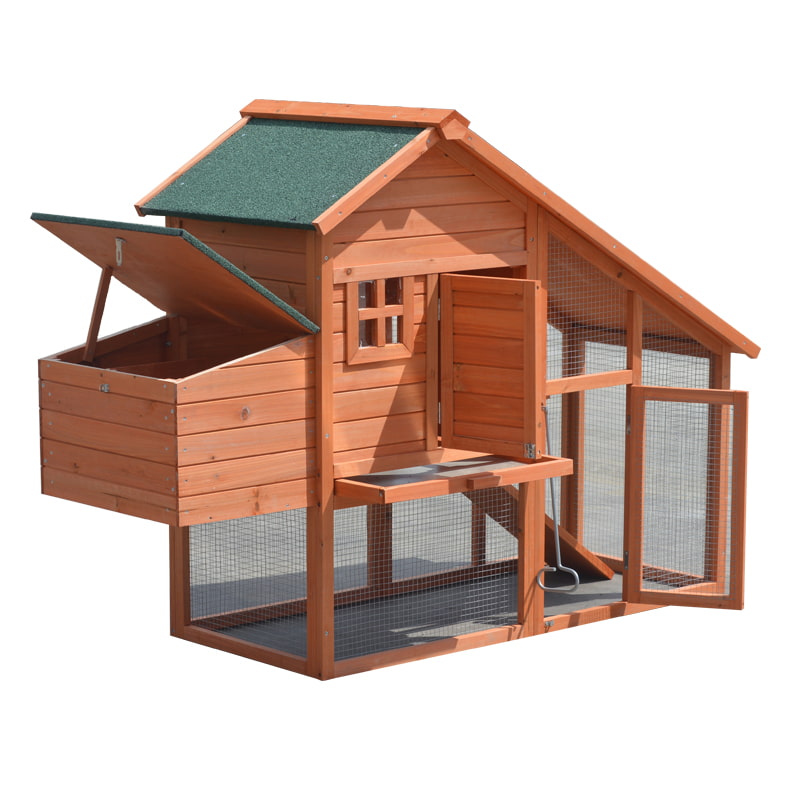
For larger breeds, dimensions may need to be adjusted. The most useful test is whether a hen can enter, stand, turn around, and settle without repeatedly hitting the sides. When choosing a wooden chicken coop with nesting boxes, review the internal nest dimensions rather than relying only on the product's overall measurements.
Nesting material is not simply decorative. It creates a cushioning layer between the egg and the box floor. When bedding is too thin, flattened, damp, or pushed into the corners, eggs may contact the hard base directly.
Utah State University Extension recommends maintaining at least 2–3 inches (5–8 cm) of clean, dry shavings in each nest box to help reduce egg breakage and soiling. The exact material and amount can vary, but the important conditions are dryness, cleanliness, and enough cushioning to remain in place when hens move around.
Check the bedding regularly:
A box can appear to contain plenty of bedding while the center has already become compressed. Inspect the actual surface where eggs rest, not just the visible material near the entrance.
When too few nesting boxes are available, hens may queue, crowd into a preferred box, or lay eggs in other parts of the coop. Adding more boxes can improve access, but it does not guarantee that every hen will use a different box. Some flocks strongly prefer one location.
Utah State University Extension suggests approximately one nest box for every four to five hens. Oregon State University describes a general ratio of one box for about every four birds. Use these figures as a starting point and observe how the flock actually uses the boxes.
| Number of hens | Initial box planning range | What to monitor |
|---|---|---|
| 4–5 | 1 box | Whether several hens compete for the same box |
| 6–8 | 2 boxes | Whether both boxes are accessible and used |
| 9–10 | 2–3 boxes | Whether crowding occurs during peak laying periods |
| 12–15 | 3–4 boxes | Whether the flock consistently favors one nest location |
If one box is used much more frequently than the others, check its position, privacy, light level, access, and bedding condition. The issue may be the location rather than the total number of boxes.
A front lip is a small structural feature with an important job. It helps keep nesting material inside the box and reduces the chance of eggs rolling out when a hen moves or leaves. Utah State University's example uses a front panel around 4–6 inches (10–15 cm) high.
The lip should not block the entrance or create an awkward step. If the entrance is too high, smaller or less agile birds may struggle to enter. If the lip is too low, bedding can spill out and eggs may move toward the opening.
Check that the front edge is smooth and free of sharp corners. The floor should also be stable, with no loose panels or gaps where eggs can become trapped. A wooden chicken coop with secure nesting box can be assessed by checking the nest entrance, front retaining edge, and access for cleaning.
Hens may sleep in nesting boxes if those boxes are positioned higher than the roosting bars or are more attractive as resting locations. Droppings then accumulate where eggs are laid, increasing cleaning work and the risk of dirty or damaged eggs.
Where possible, place roosting bars higher than nesting boxes and keep the two areas distinct. Avoid installing a perch directly above an open nest. This layout helps preserve a cleaner laying environment and makes the coop easier to maintain.
Oregon State University Extension also recommends placing nest boxes above the floor and considering a sloped top to discourage chickens from perching on top of them. This is a useful design detail because a flat upper surface can become an unintended roosting spot.
When cracked eggs become a recurring issue, change one factor at a time and record what happens. This makes it easier to identify whether the main problem is box design, bedding, flock behavior, or shell quality.
For distributors and importers reviewing a wooden chicken coop product selection, these details can also become part of a product inspection checklist. A useful specification should identify nest-box dimensions, the number of boxes, access design, front retaining structure, and whether the bedding area can be cleaned easily.
A common reference size for standard backyard hens is approximately 12 × 12 × 12 inches. Utah State University Extension gives a broader guideline of 12–15 inches in height and width, with at least 12 inches of depth. Larger breeds may need more room.
Utah State University Extension recommends at least 2–3 inches of clean, dry shavings. Check the bedding regularly because hens can compress or push it aside during use.
A useful starting point is two or three boxes. Extension guidance commonly ranges from one box for every four to five hens, but flock behavior should determine whether additional boxes are needed.
A front lip helps retain bedding and reduces the chance of eggs rolling out. It should be high enough to contain the nesting material but low enough for hens to enter comfortably.
Yes. Insufficient bedding, an unsuitable box size, hard or uneven surfaces, and crowding can contribute to egg damage. However, fragile shells can also be related to nutrition, age, or health, so inspect both the coop and the flock.
About Shaw Ye: Fuzhou Shaw Ye Arts & Crafts Co., Ltd. manufactures wooden pet houses and animal cages, including wooden chicken coops. For a practical coop design, the nesting area should be considered together with roosting positions, cleaning access, ventilation, and the daily movement of the flock.


 IPv6 network supported