Feb 09, 2026
Chicken Manure Composting Guide
Composting chicken manure (also known as decomposition or aging) is a very important and common practice in agricultural production. This is not only for treating livestock and poultry waste, but also a key process for transforming waste into high-quality resources.
The main reasons why farms don't directly apply fresh chicken manure to farmland but instead spend time and effort composting it are as follows:
1. Eliminating the harm caused by direct application of chicken manure (core reason)
Using fresh chicken manure directly without treatment can cause serious damage to crops and soil:
"Seedling burn" and "root burn": Fresh chicken manure continues to ferment in the soil, producing large amounts of heat and harmful gases such as ammonia, causing damage to crop roots, commonly known as "root burn," and in severe cases, leading to seedling death.
Spread of pests and diseases: Chicken manure may contain a large number of harmful bacteria, insect eggs, and weed seeds; direct application is equivalent to introducing these hazards into the farmland.
Difficulty in nutrient absorption: Nutrients in fresh chicken manure (such as nitrogen) mainly exist in organic form, which crops cannot directly absorb, resulting in slow and uneven fertilizer effects.
2. Transforming Nutrients into Absorbable Forms (Main Purpose) The composting process is a decomposition and stabilization of organic matter under the action of microorganisms.
Its core purposes are:
Mineralization: Converting the complex organic nitrogen and organic phosphorus in chicken manure into inorganic nitrogen (ammonium nitrogen, nitrate nitrogen) and available phosphorus that crops can directly absorb and utilize.
Humification: Generating stable humus, the core of soil fertility, improving soil structure, and enhancing water and fertilizer retention capacity.
3. Obtaining Stable, Safe, and Efficient Organic Fertilizer Fully composted chicken manure fertilizer has many advantages:
Safe and Harmless: The high temperature during fermentation (up to 60-70℃) effectively kills most pathogens, insect eggs, and weed seeds, eliminating odors.
Long-Lasting and Mild Fertilizer Effect: Stable nutrient release without burning roots, providing both quick-acting nutrients and long-lasting fertility.
Soil Improvement: Rich in organic matter and humus, it improves soil structure, alleviates soil compaction, and increases the activity of beneficial microorganisms in the soil.
Environmentally Friendly: It avoids air pollution and eutrophication caused by manure accumulation, achieving internal recycling within agriculture.
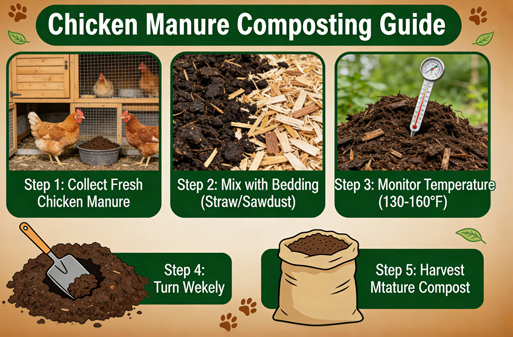
The following are the key operational steps and essential points for converting chicken manure into high-quality compost:
1.Planning and Design
Develop a composting management plan in accordance with local regulations. Choose a composting site away from water sources, roads, and residential areas, and use compost bins or compost troughs, ensuring the bottom is waterproof.
2. Raw Material Preparation and Mixing
You will need to adjust the carbon-to-nitrogen ratio (C/N): Chicken manure (high in nitrogen) needs to be mixed with high-carbon materials (such as bedding, straw). Target C/N ratio: typically between 15:1 and 35:1. Moisture content: The mixture should be moist but not water-squeezable, with a moisture content of approximately 40-60%.
3. Composting Process Management
Creating a Favorable Environment: Providing oxygen through turning the compost to maintain microbial activity. Temperature: The core temperature of the compost pile should be maintained at 54-65°C for several days to kill pathogens and weed seeds. Turning the Compost: Turn the compost as the temperature drops, usually several times.
4. Decomposition and Storage
Completion of Decomposition: When the temperature stabilizes and approaches ambient temperature, it signifies that it has entered the decomposition stage. Decomposition Time: Typically takes 1-3 months. After decomposition, it should be odorless and dark brown. Storage: Avoid rain to prevent nutrient loss.
5. Quality Testing and Application
Safe and Effective Use: Prioritize nutrient content analysis using laboratory methods. Application: Avoid application during the rainy season, freezing temperatures, or flooding. Method: Plow into the soil within 24 hours on cultivated land; for pasture, apply in small granule form.
In addition to the basic procedures, the following key points are directly related to the success, compliance, and safety of composting:
Biosafety and Disease Control: Chicken manure may carry pathogens such as avian influenza. High-temperature treatment (>54°C) is crucial for killing pathogens.
Environmental Protection: Odor and Fly Management: The composting process produces odors and attracts flies. Ensuring a proper carbon-to-nitrogen ratio, timely turning of the compost, or covering with a tarpaulin can effectively control flies.
Water Body Protection: Composting sites must be far from water sources and wells, and buffer zones must be in place. Never apply manure to flooded areas, steep slopes, or frozen ground.
Regulations and Community Relations: Many areas have strict regulations regarding manure storage, application time, and distance from water sources.
Consider wind direction and neighbors before application. Avoid operating on weekends, holidays, or at night. Notify neighbors in advance if necessary.
Read More



 IPv6 network supported